01
Yes — you can pay almost any bill with Bitcoin in 2026
You can settle rent, utilities, credit cards, mortgages, taxes, and tuition in Bitcoin today. Almost no biller accepts BTC directly — but the rails behind Lightning Pay convert your BTC to fiat and send a standard ACH/SEPA/Faster Payments transfer to the biller in your local currency.
From your perspective it's one tap. From the biller's perspective it's a normal bank transfer.
02
How Bitcoin bill-pay works under the hood
- Your wallet holds non-custodial BTC.
- A bill-pay partner (BitPay, Bitrefill, Strike, Spritz) accepts a Lightning payment.
- The partner sells the BTC and sends fiat to the biller via ACH/SEPA/wire.
- You get a confirmation; the biller receives a normal payment in 1–3 business days.
03
What kinds of bills can I pay?
- Electric bills (Duke, ConEd, PG&E, ComEd, Dominion)
- Phone bills (AT&T, Verizon, T-Mobile, Mint, Vodafone)
- Internet bills (Comcast, Spectrum, AT&T Fiber, Fios)
- Water, gas, waste
- Rent
- Credit cards
- Taxes (IRS, state DOR, property)
- Mortgages
- Gift cards (Amazon, Walmart, Uber, 5,000+ brands)
04
Step-by-step in Lightning Pay
- Download Lightning Pay desktop.
- Fund the wallet with BTC.
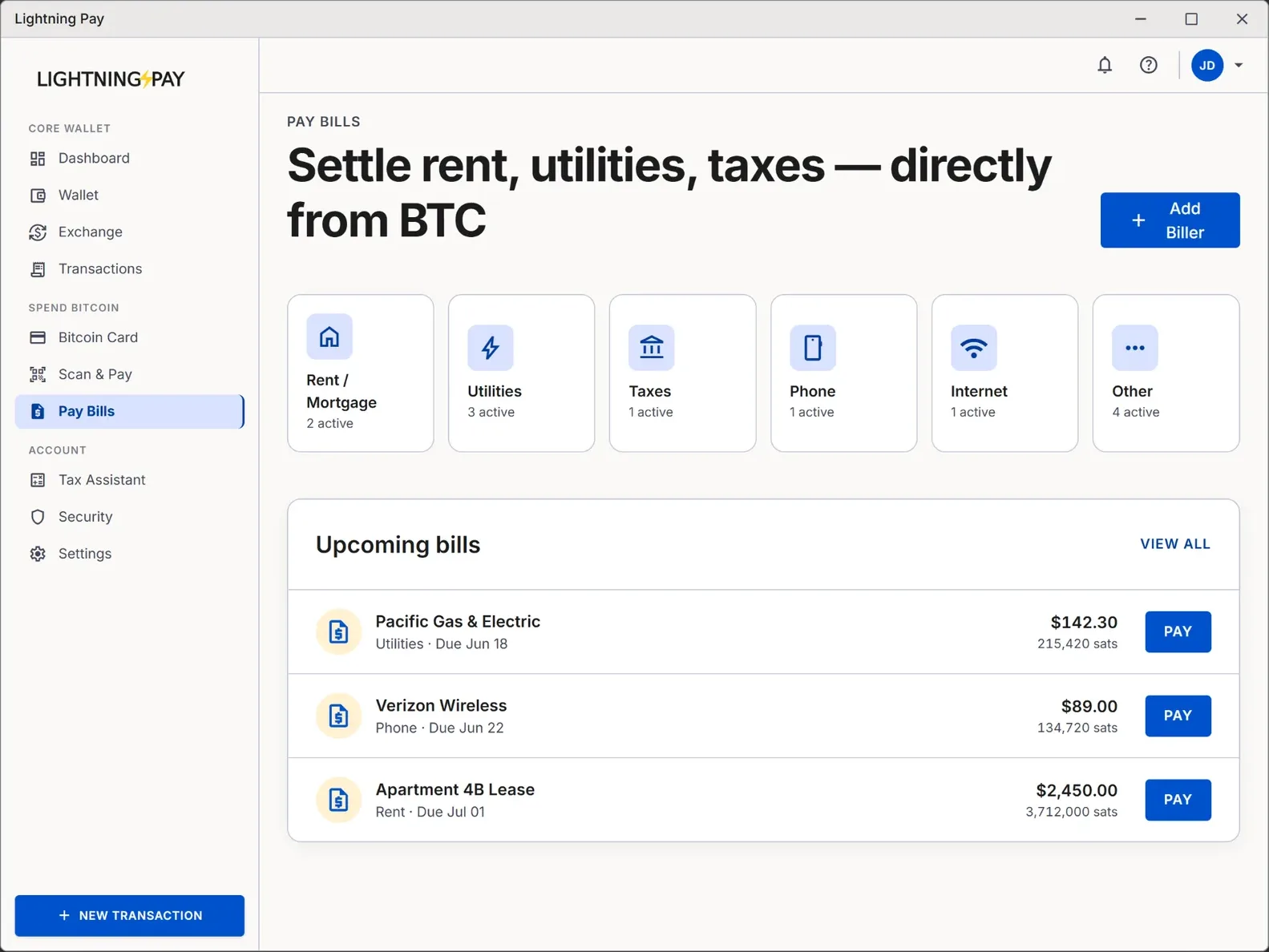
- Open Bill Pay, search for your biller (or "Other" for any ACH-accepting payee).
- Enter account number and amount.
- Confirm the Lightning payment. Lightning Pay shows the total fiat the biller will receive and the all-in fee.
05
Bill-pay fees in 2026
- Lightning network fee: typically < $0.01.
- Partner conversion spread: 1–2.5%.
- Biller ACH fee: $0–3 depending on payee.
- Typical all-in: 1.5–3%.
06
Auto-pay and DCA
Lightning Pay's Auto-Pay lets you schedule recurring bill payments and optionally top up the wallet with Auto-DCA the day before each due date.
07
Tax treatment
Spending BTC is a taxable event. The built-in Tax Assistant tracks every bill-pay transaction with cost basis attached for clean year-end exports.
08
FAQ
Ready to own your Bitcoin?
Lightning Pay is free, open source, and non-custodial. Your keys never leave your device.